
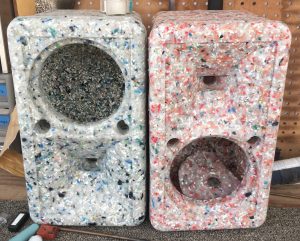
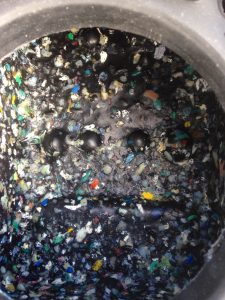
Yes. We make several models of solar powered shredder. These devices allow you to shred mixed plastic types into small particles that can be ingested into LightManufacturing Solar Rotational Molding systems. This allows for closed-loop / local re-processing of waste materials. Shredded plastic is also dense and can be efficiently transported to larger facilities for re-processing.
Yes, Solar Rotational Molding can ingest / use beach-collected plastic waste with good results, particularly if the product design is tolerant of thick walls to make up for the reduced strength of environmentally-degraded plastics. With the use of a small percentage of ‘bonding’ resin (new plastic that is good at binding different plastics and contaminants together, plastic parts can be molded at 60% beach plastic waste or more. Landfill-sourced plastics can also be used, at even higher percentages if of known type (eg sorted polyethylene).
We are working hard to commercialize this important circular-economy technology.


LightManufacturing’s patented SRM (Solar Rotational Molding) process uses sun-tracking mirrors called heliostats, to concentrate solar energy on a rotational mold. We have developed a uniquely capable heliostat, called the H1. Heat from the sun directly warms the mold, melting the plastic. Because the process uses heat directly in the molding process, the system is highly efficient: 75% efficient as compared to typical photovoltaic efficiency of 15% or less. There’s no need to convert light into electricity, nor does energy have to be transported via expensive transmission lines to market.
Zero pollution is generated in SRM, zero greenhouse gasses are emitted, and all fuel costs are eliminated. Our solar factories can be deployed in any sunny area, and infrastructure is required. We can put factories close to customers, reducing product shipping costs.
Rotational molding is a globally-used technique for making large plastic objects. Over 3.6 billion pounds of plastic are rotationally molded each year. Unfortunately, the process is energy intensive and uses non-renewable energy sources like natural gas and kerosene. Over 18.4 trillion BTU of fossil fuel is consumed by the rotational molding process, generating over 2.15 billion pounds of greenhouse gasses annually.
Rotational molding is an excellent way to make large, life-improving products like water and septic tanks, boats, docks, toys, and much more. Solar Rotational Molding helps this global process cheaper to operate and much more sustainable.
Yes. Unlike inefficient solar-electric systems, our solar thermal systems capture and use over 75% of incident solar heat. Also, the purchase cost of our heliostats and molding systems is much less than the equipment needed for traditional gas-fired plastic molding. The result? Lower buy-in costs AND lower operating costs. Solar thermal plastic molding out-competes traditional processes without subsidies – a rarity in the clean-tech world. CapEx, OpEx, and Transport costs are all much less than traditional molding.
Solar Rotational Molding Systems install into areas as small as 60′ x 60′ (3600 ft2). However, most of this area is unmodified; it can be left as unimproved land, or even planted with low-height crops. Here is how the land is used:
Total: 1060 ft2 So, just 30% of the 3600 ft2 total area is occupied by objects. The balance of the land remains unchanged. Compared with the concrete-slab required to support a traditional rotational molding operation, SRM offers a far less impactful solution. Large SRM systems scale as big as needed – 12 systems pack into a single acre of land.
Yes – electricity is used to position the heliostats, and electricity is used to drive the two motors in each molding armature. For small to midsized molds, these motors are 1/2 horsepower and require a total of @ 745 watts peak power. Our Solar Rotational Molding systems include photovoltaic panels, batteries, and charge controllers – you can install an SRM system anywhere. No grid-tie electricity is needed.
Because Solar Rotational Molding uses concentrated solar thermal energy, not solar electricity, it converts a very high percentage of available solar energy to useful heat. SRM achieves 75% typical efficiency, vs solar electric’s 15-20% efficiency. This efficiency, combined with LightManufacturing’s heat management, positioning, and process control software allow mirror arrays as small as 30 m2 to generate sufficient heat to mold objects 1x1xm.
A key difference between SRM and traditional rotational molding is that SRM heats the mold target by radiative heating (efficient, directly heats the metal) vs convective heating (gas burner heats air, which inefficiently heats the metal).
35 heliostat SRM systems routinely mold 2000L water tanks.
Solar Rotational Molding is convered by several US an international patents, and is available as complete working systems (not kits or DIY solutions).
Most people think of injection molding when they think of plastic manufacturing – this process is very capital intensive, and produces high volumes of relatively small, thin-walled objects – i.e. plastic cutlery, small toys, flashlight bodies, etc.
Rotational molding is best at making relatively large objects – from something 6″ across to very large objects such as 8′ diameter water tanks or 10′ long boats, with walls up to 1″ thick. These large, heavy objects do not pack efficiently, and shipping them is essentially to ‘ship air’. As a result, Rotational Molding is distributed across all markets – European Rotomolders making parts for Europe and for export, Asian rotomolders making parts for Asia and for export, etc. The distributed nature of rotational molding allows LightManufacturing’s SRM process to be deployed as needed in solar-rich regions.
Rotational molding, and Solar Rotational Molding (SRM) can use a variety of plastics – including virgin (new) material, and recycled material. Plastics made from fossil fuel sources have many environmental issues, but the longevity and reliability of rotationally-molded plastic parts can make them compelling ‘green’ choices over the life of the product – particularly if some recycled content is used. Note that metal, wood or other materials have their own environmental issues as well.
So while plastics aren’t perfect, they have a lot to offer in the context of big long-lasting objects like water tanks, boats, furniture, and more. We think that single-use ‘ephemeral’ plastics are VERY problematic, and we are exploring ways to up-cycle some of these materials into long-lasting rotomolded products. [ A great podcast about the issues of single-use plastics is “Waste Land” by Planet Money. Again we’d point out that we think water tanks, kayaks, septic tanks and similar big durable products are quite different in benefit and impact than (for example) disposable plastic toys given away in a fast-food kids meal. ]
Solar Rotational Molding is an excellent way to close the loop and reuse post-industrial and post-consumer plastic for new products. Especially important is our ability to recycle materials in the field – near landfills and beaches – without requiring plastic waste to be transported to centralized processing facilities. The cost of transportation makes most plastic recycling uneconomical. By removing energy costs from the molding process, SRM makes the molding of ANY plastic more sustainable and affordable, while reducing greenhouse gas and particulate emissions. New plant-based plastics may offer a source for more sustainable high performance, rotationally-molded plastics. SRM applies Concentrated Solar Power / CSP to a globally-deployed industrial ”smokestack process”, and converts it into a sustainable manufacturing process – a cleantech ‘good citizen’.
Any rotational molding resin can be molded using SRM, including polyethylene, polypropylene, nylon, and other polymers. The SRM process uses CSP / Concentrated Solar Power to achieve any desired molding temperature, and often with cycle times less than ordinary rotomolding. Contact us to learn how we can help convert your traditional operation to a low-cost, sustainable manufacturing operation.
LightManufacturing H1 Heliostats are ideal for solar furnace, solar oven, and similar applications. Each H1 heliostat captures up to 2000 watts of solar heat, and directs it to a cooker, water heater, roasting enclosure, or other solar oven/furnace design. Multiple H1 heliostats can target the same enclosure to deliver very large amounts of heat. Depending on your application, LightManufacturing can supply ISO shipping container based sun furnace target enclosures, or you may construct your own target from locally available materials. Similar terms: sun furnace, solar furnace, solar oven, sun oven.
Note: Solar Rotational Molding is covered by our several US and international patents. SRM systems are available for sale, and the technology may be licensed to qualified partners.
An apparatus containing a movable or driven mirror, used to reflect sunlight in a fixed direction. As the sun moves across the sky, a heliostat makes small adjustments to the position of a mirror in order to keep reflected light on a target. The larger the mirror mounted on the heliostat, the more energy and light is delivered to the target. Multiple heliostats can reflect light onto the same target to deliver large amounts of heat and light. LightManufacturing manufactures the high performance H1 Heliostat.

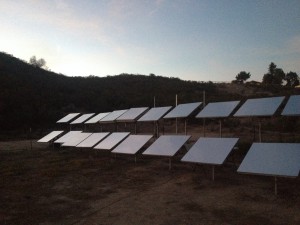

Yes! But understand: mirror size makes a big impact on shipping costs.
* Disclaimer: shipping prices are estimates only and are not guaranteed, and were provided as of 5/2020. Do not rely on these figures – get a formal quote from us!
We’re often asked where heliostats can be installed. While there are some great software tools to help ( https://www.suncalc.org/ ), there’s a simple process anyone can follow.

Note that you should check morning, midday, and afternoon to be sure you can reflect light throughout the day.
 Note also that the sun’s path will change with the seasons – remember how the sun’s path differs at other times of the year. Use a tool like https://www.suncalc.org/ to check the path for different pats of the year.
DISCLAIMER: This process depends on you doing it correctly, is for informative planning purposes only, and we don’t guarantee results without a formal, paid solar survey. This said, for most projects the above method is a useful preview of the H1 heliostat’s performance at your location.
Heliostats are the most efficient and low-cost way to harness solar energy. The uses for heliostats include:
The standard H1 heliostat ships with a 1.21M x 1.21M (48″ square) aluminum composite reflector.
In contrast to the H1, some smaller / consumer-oriented heliostats offer a mirror only .5 square meters in area, reflecting @ 425 watts of energy. It would take 4 or 5 of these small units to equal one H1 heliostat.
The LightManufacturing H1 heliostat is a powerful commercial-grade heliostat, with a number of advantages over ‘home heliostat’ systems.
Yes. Heliostats are a low cost way to capture light and heat and direct it into a building through windows. In many buildings, some rooms never get direct sunlight at all – they face the wrong way. Heliostats placed outside these cold /dark rooms can direct warmth and light into the rooms, transforming them into enjoyable, comfortable spaces. Each H1 Heliostat can deliver over 1000 watts to a room, or over 115,000 lumens of light. Multiple H1s can be combined to warm a single room faster, or you can use several H1 heliostats to warm different spaces simultaneously. Applications include schools, office buildings, homes, industrial workspaces, farm buildings, and many other architectural uses.
The H1 Heliostat is available for sale at our heliostat order page ( click here ). The H1 heliostat is available for sale to the general public in several configurations, and we also offer sales programs for commercial customers with volume purchasing needs.
Yes. In fact, heliostats like the LightManufacturing H1 are one of the simplest ways to add sustainable, low-cost solar heat and light to a new green building project, infill project, or retrofit. Heliostats are low cost, and supply heat and light through existing building windows. » Read more about heliostats for LEED / green building applications.
The H1™ heliostat employs a aluminum composite reflector which is more reflective than the best glass mirrors, but is safe, shatterproof and lower cost. A Vacuum-Focus mirror option (US Patent 9,575,222) allows for 100x concentration of the light for intense heating. The H1 incorporates advanced features including wifi-based wireless remote control and configuration (browser-based, no software required), integral microprocessors, and available on-board solar power systems.
The H1 uses a precise two-axis worm-drive system and stepper motors for accurate positioning.
The LightManufacturing H1 heliostat is an industrial-grade heliostat that combines robust performance with easy setup and operation – and at the lowest price per reflected watt of any heliostat on the market. Simply put, it costs less to heat a target with the H1 that with any other solution.
Yes – if you have a flat plate thermal collector (for example, for making hot water or hot air) the LightManufacturing H1 heliostats can help. Fixed position flat plate collectors typically do not work well in the morning or later afternoon, because they are installed in a ‘best average’ position to maximize mid-day solar absorption. This means less hot water or hot air at non-peak times. Solution: Use h1 heliostats to direct solar energy to your flat plate collector at off-peak times.
However- in many cases the additional cost of adding a heliostat to a fixed flat-plate collector may not make sense. Each case is different.